2026 KFB Congressional Tour
Posted on Mar 11, 2026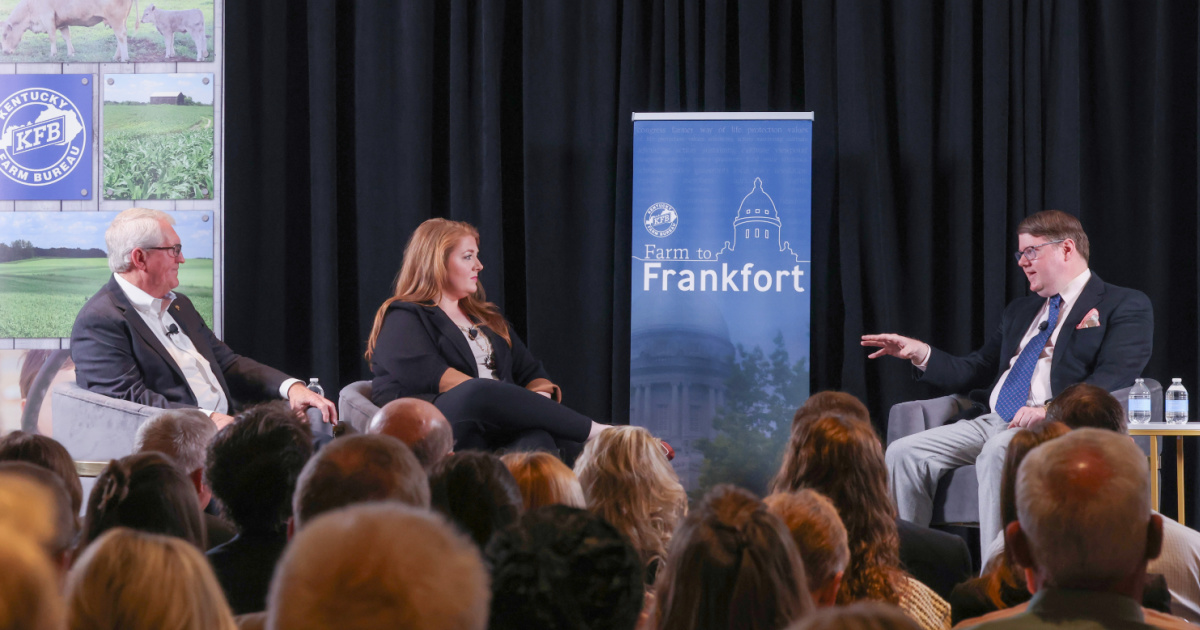
While a long-time tradition, this annual event is as important now to Kentucky agriculture as ever.
A fair estimate of visitors who make their way to the nation’s capital each year would be in the neighborhood of 27 million, according to various Washington tourism sources.
However, the 300-plus Kentucky Farm Bureau (KFB) member advocates who annually join the organization’s Congressional Tour have made this trip a regular part of their advocacy efforts.
KFB President Eddie Melton said the tour is always of importance, but with farm families facing numerous challenges, this year’s visit takes on increased significance.
“We are fortunate in the fact that each year our members get to hear from and meet with many of our Congressional delegation to let them know of the issues they are facing on the farm and to hear the latest developments on policy affecting them and their rural communities,” he said. “The value of these meetings cannot be overstated, and this trip comes at a critical time for the agriculture industry at home and across the country.”
Farm to Frankfort …from Washington
One of the main events of the tour is a special recording of the KFB Studios video series “Farm to Frankfort, ” a program launched three years ago to keep members informed about policy issues in Kentucky, through interviews with various state’ federal, and industry leaders.
This year marked the second for the “Farm to Frankfort” special during the tour. USDA Deputy Secretary Stephen Vaden and American Farm Bureau Federation Directors of Government Affairs John Walt Boatright and Brian Glenn discussed several challenges farm families are facing.
Vaden kicked off the discussions, touching on a number of national farm policy issues, followed by a lengthy question-and-answer session.
In focusing on trade and how it affects commodity prices, he said it's a supply and demand situation, and if the conversation were taking place10 or 15 years ago, it really wouldn't matter because the United States was the only country that could produce commodities in the volume that countries like China needed.
“But over the past 10 or 15 years, Brazil has not only caught up, in some areas, but they have surpassed American production, and that new supply is out there on the market, giving foreign buyers a choice of whether they want to buy what American farmers produce or whether they want to buy what Brazilian farmers produce,” he said. “And that is reflected in the price, and we've got to get that under control.”
Vaden further elaborated that people have understood that there is a difference between what American farmers produce and what Brazilian farmers produce and uses soybeans as an example.
“It's readily understood that an American soybean farmer's crop is not comparable to Brazil's; Brazil's is inferior,” he said. “When you're looking for what you want out of soy, whether it be meal or the oil, and whether you're measuring nutrition content, the American bean is better. It's just that simple. And that's before you get to other concerns, like we don't burn down the rainforest in order to bring our crops to market. They do.”
More domestic use of crops could help with commodity prices. Vaden said the most important piece of the pie for greater domestic consumption is biofuels.
“That's why we need E15, and that's why it needs to be done as soon as possible,” he said. “Anyone who's setting up there and wants to say that they're in favor of farmers earning a market-based return rather than a government check, but who is unwilling to vote for E15 is either a hypocrite or doesn't understand simple economics, one or the other.”
In speaking more about trade, Vaden said China is important, but most of the world's population doesn't live in China, and the President has been very aggressive with his use of trade authorities, and that has had some wins for agriculture.
“We need to be trading everywhere,” he said. “Every agreement that you have seen other than with China is basically in the plus column for American ag. In China, we kept it neutral for a simple reason. We don't need to be dependent on a country which, to put it mildly, does not have our best interests at heart. We should be with the rest of the world increasing how much we're selling them.”
American Farm Bureau Federation
Boatright focused much of his attention on farm labor issues and some of the legislative moves taking place over the past year to address the issue.
“I believe there have been close to eight or 10 different bills that vary in scope on addressing the ag labor challenges that we have, a lot of them centered around guest worker visa reform,” he said. When we talk about H-2A reform, which is a critical component of any ag labor legislation that we discuss, we've got very, very targeted bills that have been introduced, and we've had a lot more broad pieces of legislation that seek to approach the solution with a comprehensive look.”
Boatright added that one proposal that is garnering the most anticipation is House Agriculture Committee Chairman GT Thompson's H-2A bill.
“That bill in particular has been instigated by a report that (Thompson) spearheaded a couple of years ago with a bipartisan working group of the House Agriculture Committee, seven Republicans, seven Democrats coming together to spend about 12 or 14 months really hammering out what the real challenges are in the H-2A program.”
Boatright added that the working group produced a report that developed about 20 bipartisan recommendations largely reaffirming what Farm Bureau has long advocated for.
He concluded his discussion talking about issues specialty crop growers are having and what needs to be down to support that sector of the agriculture industry.
“Specialty crops, like the broader farm economy, have been hit pretty hard, and a lot of that has to deal with rising input costs, not least of which is labor,” Boatright said. “We've also had some pretty volatile weather conditions, particularly in the Southeast, which has dealt with some freezes that have really knocked them back by a few weeks on their windows of marketing opportunities.”
He noted that in recent years, there has been an interest from the USDA in trying to provide the assistance needed for specialty crop producers to get through these hard times.
“We must continue to be vigilant on the specialty crop side, to ensure that folks realize how important they are, no matter where they're grown, no matter what volume that they grow,” Boatright said. “A lot of fruit and vegetable producers are dealing with unique market conditions, and don't have the similar safety nets that other commodities have, and a lot of that is crop insurance related.”
However, he said a bright spot for the sector is that the USDA and Risk Management Agency are providing more crop insurance opportunities and options for these growers.
“I would just advocate that, especially if you are a specialty crop producer, that you let your voice be heard on this because we grow a tremendous amount of commodities that are diverse in nature in the United States, and we want to continue doing that,” he said.
Glenn also highlighted several issues, including the latest on moving a Farm Bill forward. And where the ag community sits with the status of nationwide, year-round E-15.
The Farm Bill is one of the priority areas on the Farm Bureau team, and I think it's not lost on us that we got a lot of our big priorities across the finish line this past July with the One Big Beautiful Bill (OBBB),” he said. “We got just about a $66 billion investment into farm programs in that bill, which is major and brings a lot of certainty for folks that need it.”
Glenn added that about $60 billion of that went into the critical risk management programs.
“They expanded crop insurance, and in talking about farmland preservation and incentivizing farmland to take over for the next generation, some of those benefits for expanding crop insurance were focused on those young and beginning farmers,” he said. “Directing policy to support that transition and make sure that folks can continue to farm, that's important and certainly a priority for our ag committee leaders, too.”
Glenn noted that while there we a lot of big wins for agriculture in the OBBB, he emphasized that because it's reconciliation, the bill was unable to address policy updates.
“Everything in a reconciliation bill has to have a budgetary effect, so our ag committee leaders, Chairman Thompson, and Chairman John Boozman of the Senate Agriculture Committee, weren't able to address a full Farm Bill.”
While the OBBB did invest in certain programs, Glenn pointed out that there's much left to do, including policy updates across all 12 titles, ranging from the credit title increasing loan limits, to the rural development title supporting rural broadband programs, to forestry and energy.
“The whole of the rural development title really was not addressed in the OBBB, so all of those important programs that help support rural communities for the longer term and bring certainty,” he said. “The Farm Bill, this Farm Bill handles a lot of those policy updates that we need.”
In his remarks about the current state of E-15 legislation and how valuable it would be to have year-round use across the country, Glenn said he thinks the number one message is that this would be hugely helpful for the farm economy for corn producers.
“Farm Bureau is a key voice, and we have played a critical role in sharing just what year-round E15 would do for the farm economy,” he said. “We're looking at an additional 2.4 billion bushels of corn in demand that would go towards year-round E15 if we can get that across the finish line. That would pay major dividends to longer term certainty on the farm in the markets.”
Glenn also said it should be a, quote-unquote, "easy button," being a bipartisan issue with many in Congress focused on the issue.
“But it's just been difficult to get it across the finish line because there are so many different players involved; stakeholders involved between oil and ethanol, biofuels and agriculture,” he said. However, I think with Farm Bureau, and the corn growers, as that ag voice, that farmer voice, we just need to continue to share the need to get this done and keep the pressure on.”
KFB Collegiate Farm Bureau
Building on these discussions about legislative priorities and the importance of advocacy in agriculture, the focus shifted to how such efforts are experienced firsthand by young farmers and students participating in programs like KFB Collegiate Farm Bureau.
A total of 18 Collegiate Farm Bureau (CFB) members from six different state universities attended this year’s Congressional Tour. This program was designed specifically for college students to enhance their future through professional development, industry networking, and educational activities, all while building awareness of KFB.
Taylor Nash, KFB Director of Young Farmer Programs, said this trip helps to provide awareness of the organization’s advocacy efforts while providing learning and leadership opportunities.
“The Congressional Tour gives these students a chance to see Farm Bureau in action at the federal level and to learn more about issues facing the state’s agriculture industry,” he said. “It also put them in a position to gain leadership skills and to see the nation’s capital, maybe for the first time. The memories they create while attending this event will last them a lifetime.”
Amy Ragland, a student at Murray State University, said the CFB experience has given her a chance to meet different people with similar interests.
“I didn’t grow up on a farm, but being involved seems like an extension in some ways of the ag programs at Murray,” she said. “It has given me a chance to meet and be around like-minded people within the Farm Bureau, and it gets me involved with my local county.
Ragland, an Ag Business major, was making her first trip to Washington, D.C., saying, “It's really big, and it's a lot, but it's been pretty cool.”
John Sibert, a senior at Eastern Kentucky University, was also making his first trip to Washington. He said coming to the nation’s capital was incredible.
“It's been one of the greatest experiences of my life and looking at all the different memorials and seeing what our country's been through, I really think every citizen of the United States of America should make a trip to D.C.,” he said.
Having grown up on a family farm in Laurel County, Sibert said agriculture has always been a part of his life. He currently serves as vice-president of the EKU Ag Club and is in his second-year participation in CFB.
“I have to say, it's been amazing, and I wish I'd joined earlier,” he said. Being involved now in CFB will help me in the future. It’s already helped me with different skills, especially with speaking and my people skills, because that's the only way you can get better is if you just put yourself out there to actually do it.”
When asked if he would carry the memories he made because of the Congressional Tour trip into the future, Sibert said 100 percent yes. “I'm just a farm boy from London, and getting the opportunities like this, I'll always carry with me for the rest of my life.”